At the end of the day most shop owners count the drawer and feel either pleased or worried. Neither tells you much. Without a record of the day's sales, you cannot say how much cash should be in the drawer, so you cannot tell a good day from a day when money went missing.
The daily sales record fixes that with one sheet a day. Every sale goes on a line, under how it was paid: cash, mobile money or credit. At closing, the cash column tells you exactly what the drawer should hold.
Print the sheet
One sheet a day. Print a month's worth and keep them in a file, by date.
DAILY SALES RECORD
| Item | Qty | Price | Cash | Mobile money | Credit (name) |
|---|---|---|---|---|---|
| Totals | |||||
Should be in the drawer = opening float + cash sales − money paid out. Mobile money and credit are not in the drawer: check them against the phone and the credit book.
How to use it
- Count the float before the first sale and write it down. This is the change money, and it should be the same every morning.
- Write every sale on its own line, with the amount in the column for how it was paid. Do it as the sale happens, not from memory at the end of the day.
- Write anything paid out of the drawer on the back of the sheet, with what it was for: transport for stock, a small supplier, a repair. Keep the receipt with the sheet.
- At closing, add up the three columns. Then work out what should be in the drawer, and count it.
- Write the difference and sign the sheet, together with whoever was selling that day.
A day on one sheet
Here is an example day at a small shop. The figures are an example.
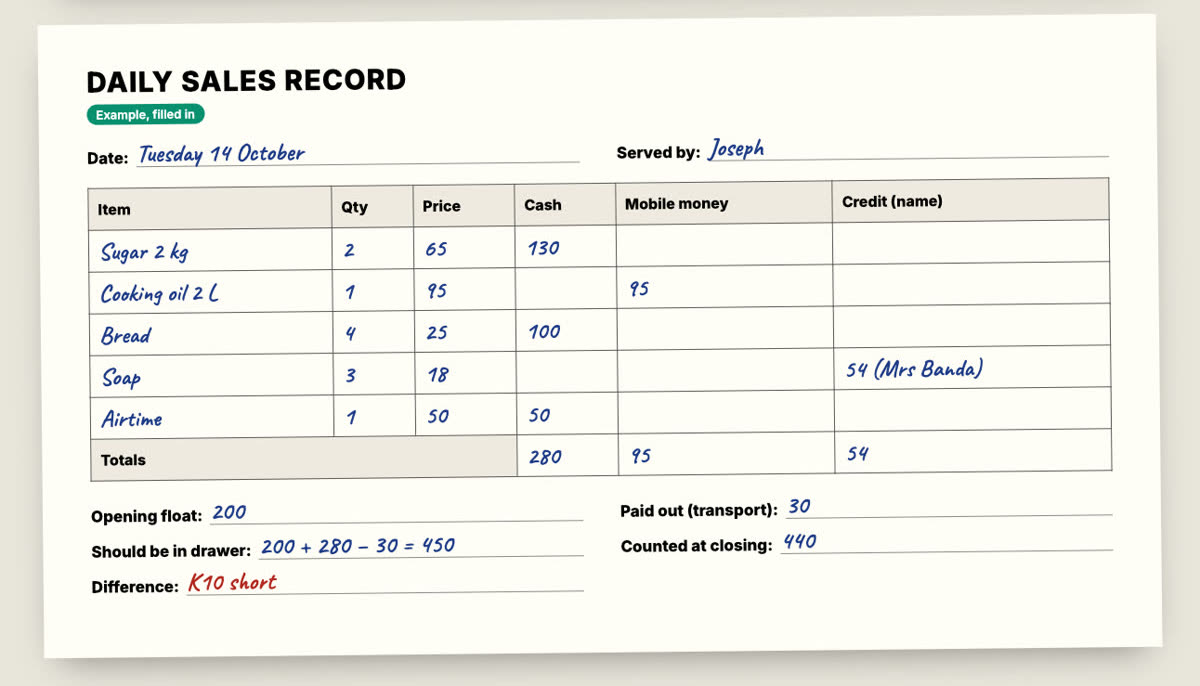
- Sales: K280 in cash, K95 by mobile money, and K54 of soap on credit to Mrs Banda. The day's sales are K429, but only K280 of it went into the drawer.
- The drawer: it opened with K200. K30 was paid out for transport. So it should hold 200 + 280 − 30 = K450.
- The count: K440. The drawer is K10 short.
K10 is small, and it may be wrong change given in a rush. But now it is a number on paper, signed, with a date and a name. If next week's sheets show K10, K20, K15 short on the same person's days, that is a pattern worth a conversation.
Keep credit separate
Credit sales are money the shop is owed, not money in the drawer. Mixing them in hides both the shortage and the debt.
- Write the customer's name on every credit sale.
- Keep a credit book, with a page per customer: what they took, when, and what they have paid back.
- Agree when they will pay, and write that down too.
- Set a limit for each customer and stick to it. Credit that is never collected is stock given away.
When the drawer is short
Most shortages have ordinary causes. Check these first, in this order:
- A sale written in the wrong column: a mobile money sale written as cash makes the drawer look short.
- Money paid out and not written down.
- Wrong change, usually at the busiest time of day.
- A sale not written at all, but the money taken.
If the shortage keeps happening, see our guide to why stock and cash go missing, which covers the routines that close the gaps and how to raise it with staff.