A stock control card answers one question for one product: how many should be on the shelf right now? Every delivery is added, every sale is taken away, and the balance is what you should find when you count. When the count and the balance disagree, you know something went missing, and roughly when.
It is the oldest stock system there is, and it still works. Below is a card you can print, an example filled in for a week, and how to use it to set reorder levels and catch shortages early.
Print the card
One card per product. Print as many as you need on plain A4 paper and keep them in a file or on a clipboard near where stock comes in.
STOCK CONTROL CARD
| Date | Received (in) | Sold or used (out) | Balance | Initials |
|---|---|---|---|---|
Balance = last balance + received − sold. Count the shelf once a week: if the count is lower than the balance, find out why.
How to fill it in
- Start with a count. Count what is on the shelf and in the store room, and write it as the first balance with today's date. Without a true starting number, every balance after it is a guess.
- Write every delivery. When stock arrives, check it against the invoice, then write the date and quantity under "Received" and add it to the balance.
- Write the day's sales at closing. Take the number sold from your sales record and write it under "Sold or used". Damaged or expired items go here too, with a note.
- Initial every line. Whoever writes the line puts their initials, so a mistake can be traced to the day and the person.
- Count every week and write the count on its own line. If it differs from the balance, write the difference.
A week on one card
Here is a card for 2 kg packets of sugar over one week. The figures are an example.
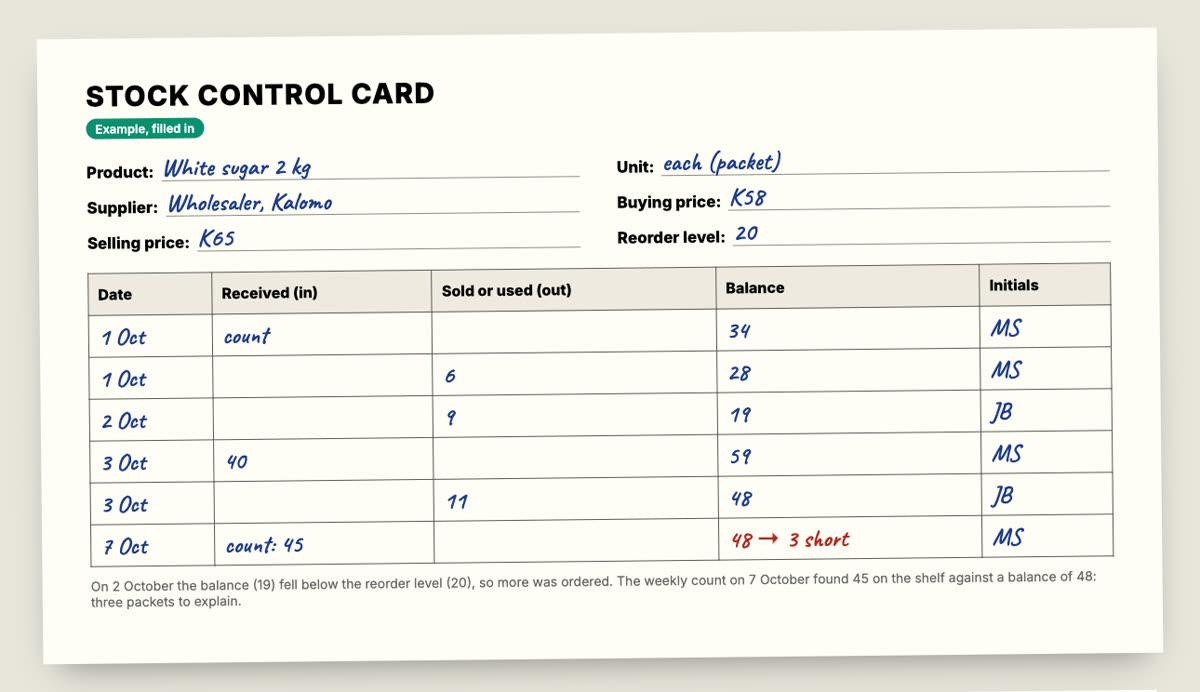
Read it line by line:
- 1 October: the count is 34. Six are sold, leaving 28.
- 2 October: nine are sold, leaving 19. That is below the reorder level of 20, so an order goes to the wholesaler.
- 3 October: 40 arrive (59), and 11 are sold, leaving 48.
- 7 October: the weekly count finds 45 on the shelf. The card says 48. Three packets, K195 at the selling price, are not where they should be.
Three packets may be a sale nobody wrote down, a packet given on credit and not recorded, or one that left without being paid for. The card does not say which, but it says that it happened and narrows down when: between the 3rd and the 7th. If the same product is short again next week, count it every day for a week and the day it goes missing will show.
Setting the reorder level
The reorder level is the balance at which you order more, so that new stock arrives before the shelf is empty. Work it out from two numbers: how many you sell in a day, and how many days the supplier takes to deliver.
Example: 4 a day × 4 days + 4 spare = 20
- Sell 30 a week (about 4 a day), and the wholesaler delivers in 4 days: reorder at 16, plus a few spare for a busy day, so about 20.
- Raise it before month end and paydays, when sales jump.
- Lower it for slow items, so money is not tied up on the shelf.
The weekly count
A card without counts is just arithmetic. The count is what turns it into control.
- Same day, same time. Before opening on Monday, for example, so no sales are happening while you count.
- Count the fast and the valuable every week: sugar, cooking oil, mealie meal, drinks, airtime. Count the rest once a month.
- Count with someone else where you can: one counts, one writes.
- Look for patterns, not single gaps. One packet short once is a mistake. A packet short every week is a leak. Our guide to why stock and cash go missing goes through the usual causes.