Almost every shop loses some stock and some cash. The owner usually feels it before they can see it: the shop is busy, the shelves empty, but somehow there is never quite enough money to restock. The losses are rarely one big theft. They are small leaks, every day, that nobody is measuring.
This guide goes through the five usual leaks, how to find which one you have from your records, and the routines that close them, without turning the shop into a place where everyone is a suspect.
The five leaks
1. Deliveries that were never fully delivered
The invoice says 40 packets; 36 came off the truck. If nobody counted before signing, the shop pays for 40 and the stock card says 40, so four packets will look "stolen" from your own shelf at the next count.
2. Sales that were never written down
The item left, the money came in, but nothing was recorded. Sometimes it is a rush at closing time and a forgotten line. Sometimes the money went into a pocket instead of the drawer. Either way the stock goes down with nothing to show for it.
3. Credit and favours that were never recorded
A packet of sugar "until Friday" for a neighbour, a drink for a relative, something for the house. Each is small and well meant. Unrecorded, it looks exactly like theft at the count, and the money never comes back.
4. Mistakes at the till
Wrong change, a price charged lower than the list, a mobile money payment written as cash. These are honest, but they cost the same as theft and are just as worth fixing.
5. Stock that spoils, breaks or expires
Bread past its day, a broken bottle, a burst bag of mealie meal, rats in the store room. This is a real cost of doing business, but it should be written down when it happens, not discovered at the count.
Finding where it goes
You cannot fix a leak until you know which one it is. The records point to it.
| What you see | Most likely leak |
|---|---|
| Stock short just after a delivery | Short delivery not checked (1) |
| Stock short, but the drawer matches the sales | Sales or credit not written down (2, 3), or spoilage (5) |
| Drawer short, stock matches the sales | Wrong change, or a mobile money sale written as cash (4) |
| Short only on one person's shifts | That person's habits: mistakes, favours or worse |
| Short on fast, valuable items only | Items that are easy to slip away: airtime, drinks, cooking oil |
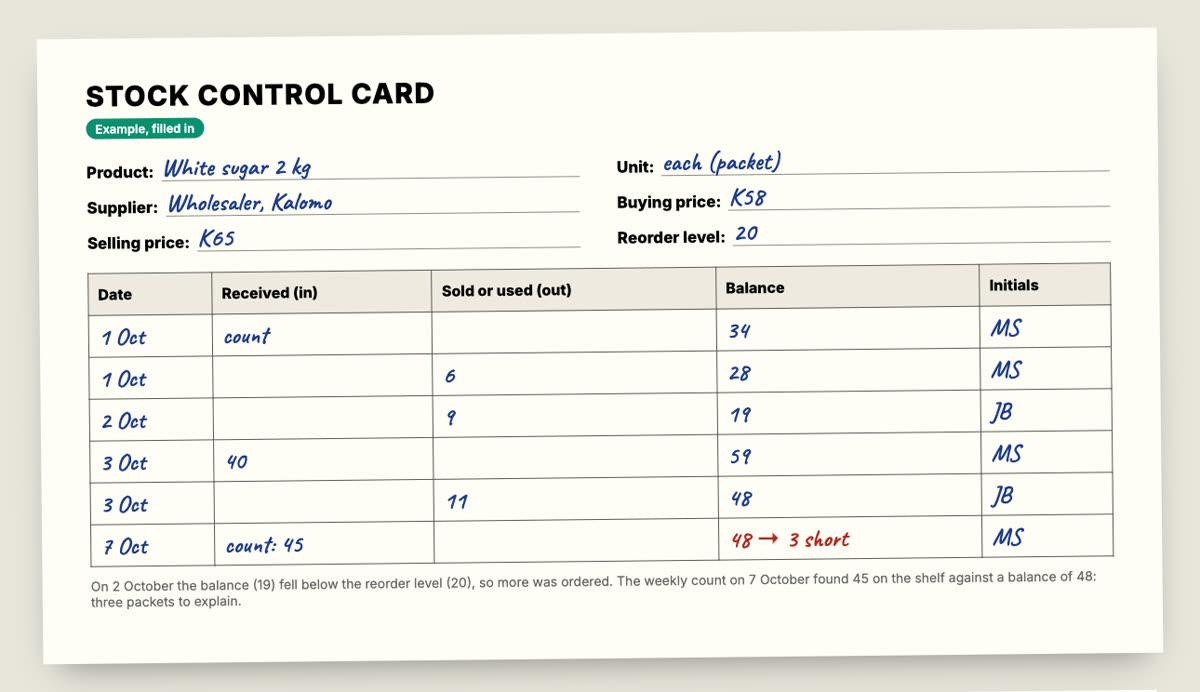
Two records do most of the work: the stock control card, counted each week, and the daily sales record, with the drawer counted each night and signed by whoever sold.
Routines that close the gaps
Each routine takes a few minutes a day. Together they make leaks visible within days instead of months.
- Count every delivery against the invoice before the driver leaves. Write what actually arrived, not what the invoice says.
- One person per drawer per shift. When two people share a drawer, a shortage belongs to nobody. Count the drawer when one person hands over to the next, and both sign.
- Every sale on the record, as it happens. No "I'll write it later".
- Credit only in the credit book, with a name and a date, and only up to an agreed limit. The owner's own household takes from the shop the same way, through the book.
- Write spoilage when it happens, on the stock card, with a note: "2 loaves, stale".
- Count the fast, valuable items every week, on a fixed day, before opening. Count everything once a month.
- Check mobile money every evening: the transaction messages on the shop phone against the mobile money column.
- Bank or remove cash during the day when the drawer gets full, and write it down. Less cash in the drawer is less temptation and less risk.
Talking to staff about it
Most staff are honest, and good staff dislike shortages as much as you do, because they fall under suspicion too. How you raise it decides whether records become a shared habit or a source of resentment.
- Explain the routines before there is a problem, as the way the shop runs, for everyone, including you.
- Talk about numbers, not character: "the drawer was K40 short on Tuesday and Thursday" rather than "you are stealing".
- Look for the honest explanation first: a sale in the wrong column, change given in a hurry, an unrecorded payout.
- Agree what happens with shortages before they happen, and apply it the same way to everyone.
- Notice the good days too. A week with the drawer exact every night deserves a word of thanks.
When records do the watching
Paper records work if they are kept every day. The trouble is that they depend on the same busy people they are meant to check, and they are easiest to skip on exactly the days when something is going wrong. A till system keeps the records as a side effect of selling.
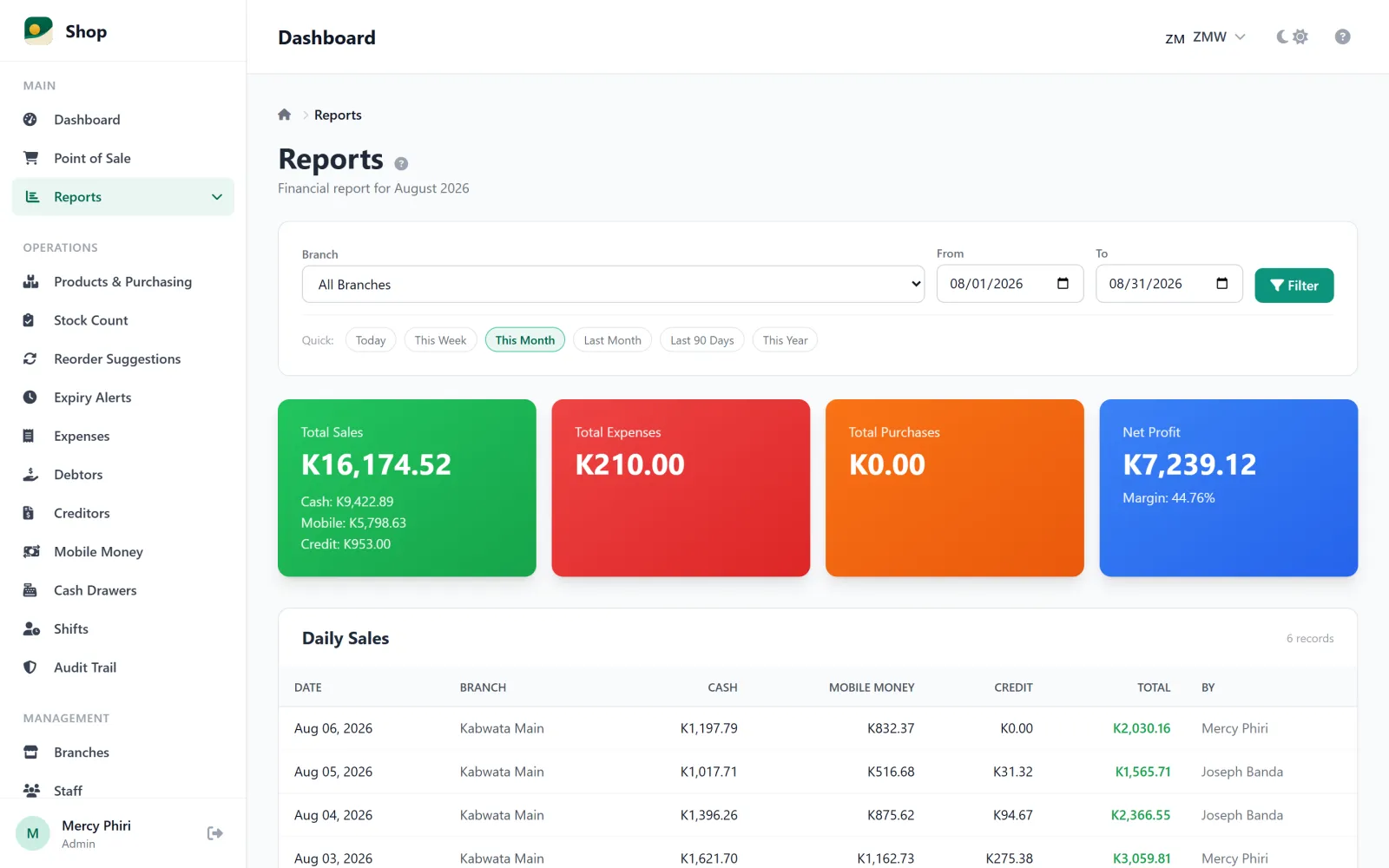
In HORIZON Shop Tracker, every sale at the till takes the item off stock and records how it was paid. Each till session is opened and closed with a cash count, and the difference between the cash that should be there and what was counted is kept against the person and the shift. A stock count shows the gap for every product at once, and an owner sees it all from their own phone, wherever they are.